
1 day ago
Mercury 3 Cuts the Wait, MiniMax Flash Cuts API Costs + Local AI for Swift Apps
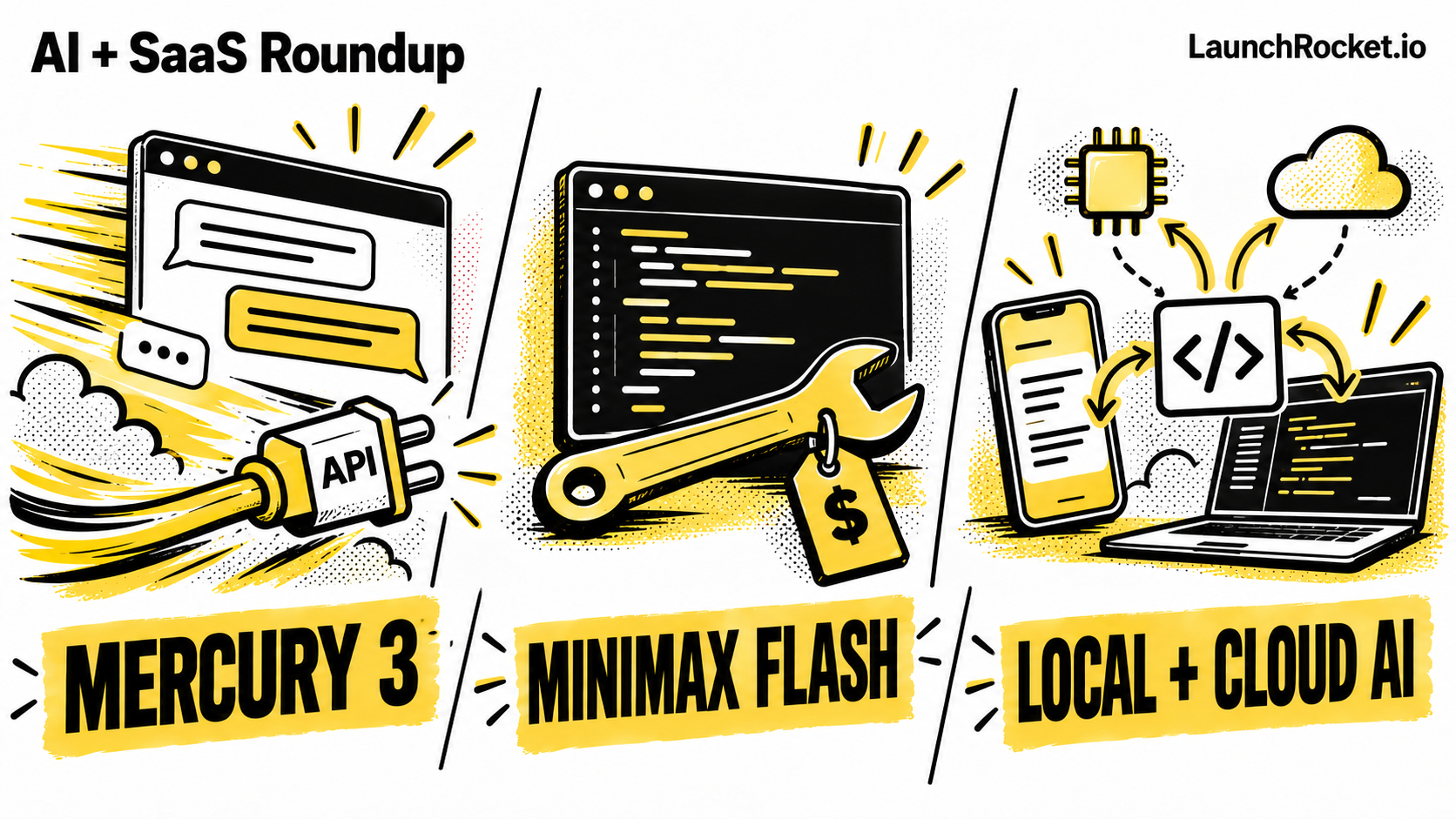
AI and SaaS Roundup · 2026-10-21
Two new models with fairly small API price tags, plus a useful release for anyone building AI into an iPhone or Mac app. There’s a difference between cheap hosted inference and something you can actually run on the device, so here’s what’s available.
Mercury 3 is here for apps that can’t keep people waiting
Inception launched Mercury 3 on 19 October, with a million-token context window and an OpenAI-compatible API. It’s available directly and through OpenRouter, Baseten and Vercel.
Inception reports generation speeds above 1,000 tokens per second on NVIDIA GPUs. That’s the company’s measurement, rather than a promise that your whole app will respond at that speed. The interesting uses are chat support, tutors and browser agents, where waiting for each model response can make everything feel slow.
The direct platform currently shows launch pricing of $0.10 per million input tokens and $0.35 per million output tokens, against listed regular prices of $0.20 and $0.70. No end date for that launch discount is stated on the public pricing page. Those are Inception’s prices; a third-party provider may charge differently.
Source: Inception’s Mercury 3 announcement
MiniMax M3.1 Flash starts at $0.15 input and $0.60 output
MiniMax also released M3.1 Flash on 19 October. Direct API pricing is $0.15 per million input tokens, $0.60 per million output tokens and $0.015 per million cached input tokens.
The release focuses on coding, tool use and computer-use tasks. MiniMax reports stronger results and lower task costs than its predecessor, but the benchmark gains are its own reported results. A support workflow that calls several tools or a coding assistant working through a repository are the sorts of jobs being targeted.
It’s available through the MiniMax API, M Plan and MiniMax Code. The weights are promised for later, so this isn’t an open-weight model you can download today. Also, the API prices above aren’t the price of an M Plan subscription.
Source: MiniMax’s official M3.1 Flash release
Swift builders can swap local and hosted models without rewriting the whole app
Hugging Face released AnyLanguageModel 1.0 on 20 October. It follows Apple’s Foundation Models API, but lets the same session code use the system model, open-weight models through MLX, llama.cpp or Core ML, and hosted providers.
Tool calling and guided generation now work across providers. Hosted options include Anthropic, Gemini and OpenAI-compatible endpoints, including OpenRouter through a custom base URL. The release also supports fetching API credentials through a closure, so an app can request short-lived tokens from its own server.
For a Mac document assistant, for example, you could offer a local model and an optional hosted model without maintaining two completely different chat integrations. Device memory still determines which local models fit, and OS 27-specific image and Private Cloud Compute features need that OS version.
Comments
Sign in to join the conversation
Sign InNo comments yet. Be the first to share your thoughts!