SaaS CRO focuses on maximizing the value of existing traffic, aiming to lift average trial sign-up rates from 3% to 5% or higher.
Mobile traffic now accounts for significant visits, making mobile-responsive pricing pages (like stacked cards) critical for future-proofing.
Reducing friction in sign-up flows and using psychological anchors on pricing pages can yield an 89% lift in conversions.
Personalization and team alignment between marketing and sales are the biggest levers for moving leads from MQL to SQL.
You are likely pouring thousands of dollars into paid ads, content marketing, and SEO, yet data from Forrester indicates that up to 97% of your visitors leave without signing up. This is the brutal reality for most software companies. Conversion rate optimization (CRO) for SaaS is not about changing button colors or guessing what works. It is a scientific approach to fixing the leaks in your funnel where revenue drains away.
The average SaaS conversion rate hovers around 3% for visitor-to-lead. If you can move that needle to just 4% or 5%, you effectively double your growth without spending a penny more on acquisition. As we approach 2026, the market is too competitive to ignore these margins. Effective conversion rate optimization for SaaS is the only reliable lever left to lower acquisition costs while increasing Customer Lifetime Value (LTV).
What Is Conversion Rate Optimization for SaaS?
SaaS CRO is the systematic process of increasing the percentage of website visitors who take a desired action. In the software world, this action varies depending on the funnel stage: it could be signing up for a newsletter, starting a free trial, booking a demo, or upgrading from a free to a paid plan. Unlike e-commerce, where the goal is a one-time purchase, SaaS CRO focuses on long-term value and retention.
The core objective is to lower your Customer Acquisition Cost (CAC) while increasing Customer Lifetime Value (LTV). By optimizing your conversion rates, you extract more value from the traffic you already have. For a SaaS business model, this efficiency is often the difference between burning out and scaling successfully.
SaaS Conversion Benchmarks: Where Do You Stand?
Before you start fixing things, you need to know what good looks like. Founders often panic because their conversion rate is 2%, not realizing that for their specific price point and industry, 2% might be excellent. However, referencing authoritative data provides a clearer picture.
According to the OpenView SaaS Product Benchmarks Report, top-performing SaaS companies see significantly higher throughput at the middle of the funnel. If you are falling below these numbers, your problem isn't traffic; it is trust and clarity.
SaaS Conversion Benchmarks vs. Optimization Potential
Metric
Average Benchmark
Optimization Lift Potential
Visitor-to-Lead
3% - 5%
Top performers hit 8%+ (Source: First Page Sage)
Lead-to-MQL
39%
50%+ via personalization
MQL-to-SQL
42%
67% with sales/marketing alignment
Free Trial-to-Paid
15% - 25%
30%+ with better onboarding
These numbers reveal a critical insight: the biggest drops often happen after the initial click. Optimizing your SaaS GTM strategy requires looking at the entire journey, not just the landing page.
The Ultimate Launch Checklist
Don't miss a step. Download our comprehensive 30-day product launch checklist PDF to audit your funnel.
Your pricing page is likely the second or third most visited page on your site, yet it is often the most neglected. Trends tracked by Statista and recent mobile indexing reports indicate that 40-60% of pricing page traffic now comes from mobile devices. If your pricing table squishes five columns into a tiny screen, you are losing half your potential leads instantly.
The Power of Anchoring
Price anchoring is a psychological principle where the first price a user sees sets the context for the rest. By placing a higher-priced Enterprise or Pro plan on the left or highlighting it as 'Most Popular', the standard plan appears cheaper by comparison. This reduces the friction of the purchasing decision.
To implement this effective SaaS pricing model strategy, ensure your preferred plan is visually distinct. Use a contrasting color for the CTA button and add a 'Recommended' tag. Data shows that anchoring can drive an 8% uplift in Revenue Per User (ARPU).
Mobile-First Design
On mobile, standard comparison tables fail. Instead, use stacked cards or accordions. Users should not have to pinch and zoom to see feature parity. A vertical layout where users swipe through plans often converts better on handheld devices. Ensure your CTAs are at least 44px high to accommodate 'fat finger' taps.
Strategy 2: Frictionless Sign-Up Flows
Every field you add to your sign-up form reduces your conversion rate. It is a simple law of the web. Research from HubSpot suggests that asking for a phone number or company size upfront can tank conversions by 20-30%. The goal of the initial form is solely to get the user inside the product.
Consider using Single Sign-On (SSO) options like Google or GitHub. This removes the need for password creation and email verification, granting instant access. If you need more data for lead scoring, ask for it after the user has engaged with the tool, a technique known as progressive profiling.
Strategy 3: Data-Driven Personalization
Generic headlines no longer work. Visitors expect your site to understand who they are. According to the McKinsey Next in Personalization Report, companies that excel at personalization generate 40% more revenue from those activities than average players. This doesn't mean just swapping out a name; it means tailoring the value proposition based on the traffic source or user behavior.
The Tech Stack: A Comparative View
CRO Tooling Comparison Matrix
Category
Leading Solution
Primary Strength
Best For
Auto-Capture Analytics
Heap
Retroactive Analysis
Teams that forgot to set up tracking events beforehand.
Deep Segmentation
Mixpanel
Complex Cohorts
Power users asking specific 'why' questions about churn.
In-App Onboarding
Pendo
Walkthroughs & Guides
Solving the 'Empty State' problem without code.
Qualitative Data
Hotjar / Clarity
Heatmaps & Recordings
Visualizing exactly where users get stuck on a page.
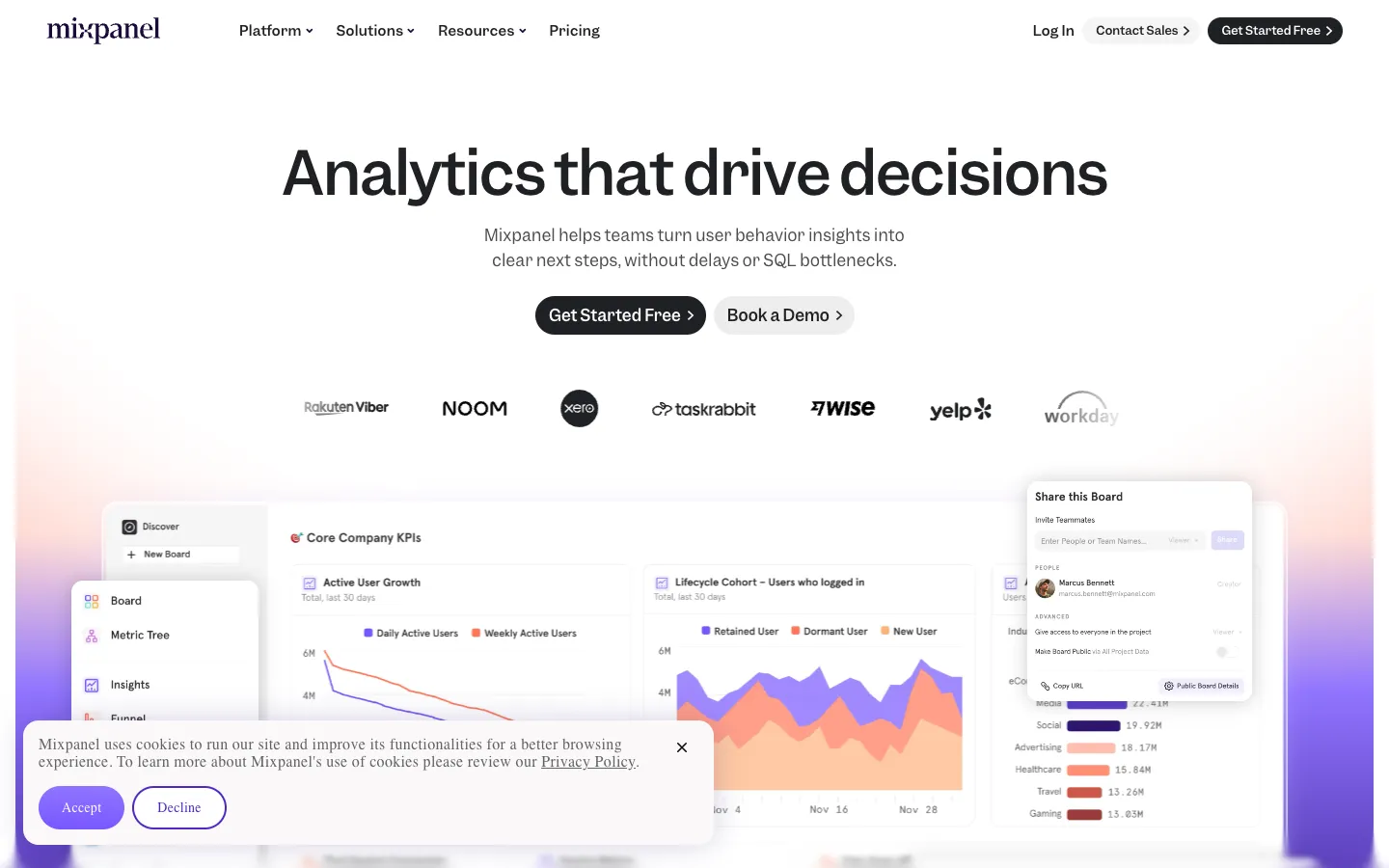
Funnel analysis tools allow you to visualize exactly where users drop off, as seen in this segmentation view.
Strategy 4: The Empty State Onboarding Problem
The moment a user signs up, the clock starts ticking. If they land on a dashboard that is empty, confusing, or devoid of data, they will churn immediately. This is the Empty State problem. Your goal is to get them to the 'Aha! Moment' as fast as possible.
Use dummy data or templates to show the user what the tool looks like when fully utilized. For example, a project management tool should pre-load a sample project. A marketing tool should show example analytics. This visual proof builds confidence and reduces the cognitive load required to get started.
Join 2,000+ Founders
Get the latest SaaS launch strategies, CRO tips, and updates delivered to your inbox.
In B2B SaaS, risk aversion is your enemy. Buyers are terrified of making the wrong choice. You must mitigate this fear with overwhelming social proof. But sticking a few logos on the homepage is not enough.
Place testimonials and case study snippets directly next to friction points, such as the 'Book a Demo' button or the credit card field. This is known as Point-of-Action Assurance. Studies on trust indicators suggest that specific placement of credibility markers can increase conversion rates by up to 400% on high-friction pages.
How to Run a SaaS CRO Audit (Step-by-Step)
1. Quantitative Analysis
Use your analytics stack (as defined in the comparison table above) to auto-capture every click and swipe. Look for pages with high bounce rates or drop-offs. If 80% of users leave the pricing page without clicking a plan, you know exactly where to focus.
2. Qualitative Feedback
Numbers tell you *what* is happening; humans tell you *why*. Install session recording tools to watch users struggle. Are they rage-clicking a non-clickable element? Are they scrolling past your key value prop? You can also use on-site polls to ask, 'What is stopping you from starting a trial today?' The answers will surprise you.
3. Hypothesis and Testing
Formulate a hypothesis based on your findings. Example: Because users are dropping off at the phone number field, removing it will increase sign-ups by 15%. Then, run an A/B test. Remember, for a statistically significant result, you typically need around 2,700 visitors per variation. Do not stop the test early just because one version is 'winning' on day two.
Common Mistakes in Conversion Rate Optimization for SaaS
Even experienced marketers fall into traps. The most common error is testing too small. Changing a headline from 'Get Started' to 'Start Now' rarely moves the needle. You need to take big swings, redesign the page layout, change the pricing model entirely, or overhaul the messaging strategy.
Another mistake is ignoring speed. Core Web Vitals are a ranking factor and a conversion factor. A one-second delay in page load can reduce conversions by 7%. Ensure your images are compressed and your scripts are optimized. If your site feels slow, users assume your app will be slow too.
Ready to Launch?
Join hundreds of founders launching their products with LaunchRocket. Get more eyeballs on your product today.
•Maximizes the value of existing traffic without ad spend.
•Improves user experience, leading to higher retention.
•Provides data-driven insights for product development.
Cons
•Requires significant traffic volume for statistical significance.
•Can be resource-intensive to design and implement tests.
•Risk of 'local maxima' (optimizing a bad page instead of fixing the root cause).
•Results are not always immediate; requires iteration.
Pro Tip
Mobile traffic is dominant. If your pricing page isn't using stacked cards for mobile users, you are likely losing 50% of your leads.
Don't guess. Use session recording tools to watch real users struggle with your UI. The friction points are usually obvious when you see them.
Test big changes first. Micro-optimizations (button colors) only matter once you have high traffic. Early on, test your core value proposition.
Frequently Asked Questions
How to improve SaaS conversion rate?
To improve conversion rates, focus on reducing friction in your sign-up flow (e.g., removing credit card requirements for free trials), optimizing your pricing page for mobile devices, and using social proof like testimonials near call-to-action buttons. Speed also matters; ensuring your site loads in under two seconds is critical.
What is the conversion rate for SaaS companies?
A typical benchmark for visitor-to-lead conversion in SaaS is between 3% and 5%. However, top-performing companies often achieve rates of 8% to 10% by rigorously testing their value propositions and user experience.
What is the CRO for SaaS?
CRO for SaaS (Conversion Rate Optimization) is the systematic process of increasing the percentage of website visitors who perform a desired action, such as signing up for a trial, booking a demo, or upgrading a subscription, specifically within a recurring revenue business model.
How to do conversion rate optimization?
The process involves four steps: 1) Analyze quantitative data (analytics) to find drop-off points. 2) Gather qualitative insights (heatmaps, user recordings) to understand why users leave. 3) Formulate a hypothesis and run an A/B test. 4) Analyze results and implement the winner.
Does site speed affect SaaS conversion?
Yes. A one-second delay in mobile load times can impact conversion rates by up to 20%. Optimizing Core Web Vitals (LCP, FID, CLS) is a fundamental requirement for maintaining a healthy conversion funnel.
Arielle Phoenix
Founder
At LaunchRocket I help founders get their first 100 customers. At Metronyx AI I help brands scale their organic SEO and AEO.
Join the Newsletter
Get growth tactics and launch strategies delivered to your inbox for builders like you.